
Economic shifts put mission-driven organizations in a tough spot. Revenue changes, funding tightens, demand moves, and suddenly leaders are being asked to make big decisions with very little room for error.
Cutting costs can create immediate breathing room. But when those cuts reach the people, systems, relationships, and capabilities that took years to build, the short-term savings can come with a much bigger long-term price.
The goal is not to freeze everything in place. It is to know what needs to flex, what needs to stay protected, and where existing assets can be put to work in new ways. That is the difference between reacting to economic change and building an organization that can move through it.
Summary & Key Takeaway: How to navigate economic shifts
- Some Cuts Do Not Heal:
Knee-jerk budget cuts and footprint reductions in response to short-term downturns often destroy decades of institutional investment and cost far more to rebuild later.
- Distinguish Fixed Capacity from Variable Demand:
Revenue volatility exposes the danger of funding models that treat core operations as purely variable costs.
- Reposition Existing Assets Before Abandoning Them:
When market conditions shift, the solution is rarely to scrap core offerings; it is to reframe them from isolated features into critical infrastructure.
- Protect Legacy Knowledge Through Upskilling:
Organizations that retrain internal staff and preserve core capabilities bounce back faster when the economic cycle inevitably recovers.
The Problem: The Hidden Trap of Reactive Downsizing
When external pressures mount, leaders face immediate panic. Across every sector, external pressures are accelerating simultaneously: demographic shifts, persistent inflation, intensifying competition, and shrinking funding pools.
The instinctive reaction is often a reflexive contraction. Organizations rush to slash budgets, freeze initiatives, reduce staff, and shrink their operating footprint. But reactive cuts made to balance a single budget cycle frequently create structural damage that lasts for years.
This dynamic is playing out vividly in Texas public schools. Facing a drop of nearly 76,000 students driven by falling birth rates, demographic shifts, and the expansion of parallel choices like Education Savings Accounts (ESAs) and charters, districts have slated at least 130 campuses for closure or consolidation over two years.
The immediate math looks tidy on a balance sheet, but the operational reality is more complicated:
- Texas public school infrastructure represents decades of public investment across 9,000 campuses serving 5.5 million students.
- When a neighborhood school closes, reopening it years later is rarely possible on the same footprint, forcing communities into expensive commercial leases or costly new builds.
- Core operating costs do not scale down in neat lockstep with demand; a building, a principal, and baseline staff are required whether an organization serves 400 people or 280.
The lesson applies far beyond school districts. Cut core capacity too deeply in response to short-term headwinds, and rebuilding that trust, footprint, and capability during an economic rebound can cost significantly more than preserving some flexibility today.
The Solution: The HarborWay Foundations Operational Continuity Framework for How to Navigate Economic Shifts
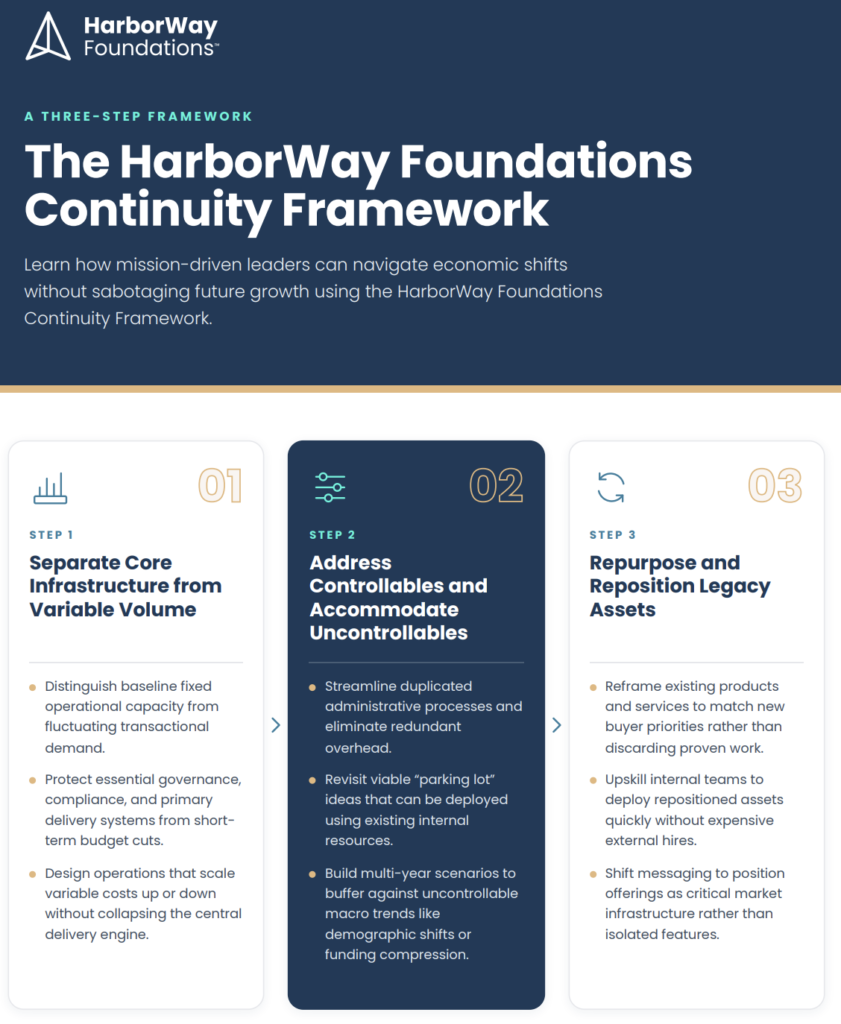
Navigating uncertainty requires a structure that flexes without breaking. The HarborWay Foundations Operational Continuity Framework provides a disciplined method to manage economic shifts without dismantling future capacity:
- Separate Core Infrastructure from Variable Volume: Distinguish baseline fixed capacity from fluctuating transactional demand.
- Address Controllables and Accommodate Uncontrollables: Move swiftly on internal cost leaks and workflow bottlenecks while establishing buffers for macro demographic or funding trends.
- Repurpose and Reposition Legacy Assets: Reframe existing products and upskill internal teams to match new buyer priorities instead of discarding proven work.
Step 1: Separate Fixed Foundation Costs from Variable Demand
In the Texas school finance system, funding follows Average Daily Attendance, creating immediate budget volatility whenever student counts fluctuate. The formula assumes operating expenses fall neatly alongside attendance, ignoring the fixed reality of core facilities and baseline administrative leadership.
Mission-driven leaders often make the same mistake by treating operational infrastructure as discretionary.
- Audit Your True Base: Identify the irreducible core of your operation, including essential governance, compliance, primary delivery systems, and key leaders.
- Avoid Flawed Cost Reductions: Do not eliminate high-leverage foundational assets to solve short-term margin deficits.
- Protect Flexible Capacity: Design operations that can scale variable project costs up or down without collapsing the central delivery engine.
Step 2: Act Rapidly on Controllables, Accommodate What You Cannot Shift
Macroeconomic inflation, state legislative changes, and demographic cliffs are beyond your control. What remains entirely within your control is how your organization manages internal resources, prior initiatives, and operational discipline.
- Sift the “Parking Lot”: Revisit viable ideas previously set aside because business was steady.
- Eliminate Redundant Overhead: Streamline duplicated administrative processes and overlapping systems that dilute focus.
- Build Predictable Runways: Model scenarios around multi-year enrollment, client, or donor pipelines rather than reacting quarter to quarter.
Step 3: Reposition Existing Assets Instead of Throwing Them Out
When performance declines or growth stalls, organizations frequently assume their core offering needs a complete overhaul. In reality, the service is often fundamentally sound, but its narrative and positioning have failed to adapt to current buyer constraints.
Consider HyverHub, a full-service fulfillment partner serving mission-driven organizations in healthcare and education. They had deep, cross-sector capabilities, including warehousing finished products, producing pre-sale materials, and managing API-driven shipping. But their instinct was to say everything to everyone, resulting in a diluted message that resonated with no one. The operational assets were highly valuable; what they needed was a go-to-market story as focused as the work itself.
Instead of abandoning or rebuilding their core service lines, HarborWay Foundations partnered with HyverHub to evaluate where they were already winning and reposition their existing capabilities.
- Reframed the Value Proposition: Rather than pitching commodity fulfillment features, HyverHub was repositioned as a strategic partner that understands the operational complexity and brand trust behind every order it fulfills.
- Targeted Revenue-Focused Buyers: The messaging architecture was sharpened to speak directly to the procurement leads, marketing directors, and operations managers who actually sign contracts, without artificially narrowing the broader market.
- Equipped the Internal Team: HarborWay Foundations defined targeted Ideal Customer Profiles (ICPs) and built pitch decks, outreach copy, and sales tools so the internal team could open conversations immediately.
The outcome proved the power of repositioning: HyverHub secured a clear, consistent story and a scalable go-to-market plan without discarding their established operational foundation.
Implementation Guidance for Small Teams
If you operate with a lean staff of 1 to 3 people, execute these low-lift steps:
- Run an Asset Inventory: List your existing core services, tools, or published assets; identify which ones can be repackaged for immediate revenue rather than developing new offers from scratch. Check out The Four Phases Mission ROI Lens
- Isolate Fixed Overhead: Calculate your absolute minimum operating cost per month; avoid cutting the 1 or 2 core operational tools that generate your pipeline.
- Upskill via Drop-In Support: Partner with an external drop-in team that embeds alongside your staff to design strategy and execute campaigns. Have them train one key internal member on critical workflows, ensuring outside help builds lasting in-house capability rather than permanent dependency. Check out The Four Strategy Lanes
Simple Metrics to Measure Success
Track these operational indicators to verify you are building resilience rather than setting off a cycle of organizational decline:
Core Capacity Retention Rate: Percentage of essential program infrastructure and key talent preserved through budget adjustments
During the early months of the COVID-19 pandemic, semiconductor suppliers diverted parts away from the auto industry to consumer electronics. When vehicle demand rebounded rapidly, automakers like Ford lacked the core components to build cars, causing a 33.1 percent sales decline in August 2021 and costing the global auto industry billions in lost revenue.
Repurposed Asset Velocity: Turnaround time required to re-message and deploy an existing offering into a new market channel.
Stanley turned its 40-ounce insulated cup from a utilitarian camping item into a fashion accessory by partnering with a women’s commerce blog. Introducing new colors to this targeted audience transformed a discontinued item into a viral success, growing the company’s annual revenue from $70 million to over $750 million in just four years.
Fixed-to-Variable Cost Ratio: The operational proportion between stable baseline costs and adjustable programmatic expenses.
A prime example of improving this ratio is using an outside agency to build out a one-time program playbook. This approach leverages outside expertise and protects internal capacity while creating a ready-to-execute plan. It also gives the initiative room to be evaluated objectively, without internal assumptions or ownership getting in the way. This is exactly where HarborWay Foundations can be brought in as a strategic partner. To see where your current strategy holds and where it leaks, take the free HWF Pulse Check.
Frequently Asked Questions (FAQ)
A cut is a knee-jerk reaction when it eliminates core operational capacity, discards valuable institutional knowledge, or permanently shuts down facilities to meet an arbitrary single-cycle target. If rebuilding that capacity during an eventual uptick will cost more than the money saved today, the cut is shortsighted.
Launching a brand-new initiative requires heavy capital, long development cycles, and significant market testing. Repositioning an established product leverages your existing credibility and infrastructure, aligning your proven value with current buyer budget priorities in a fraction of the time.
Organizations must separate their fixed baseline operational expenses from their variable service costs. Relying entirely on per-unit or attendance-based revenue models leaves zero cushion during downward shifts, creating instant operating deficits that threaten organizational survival.
How HarborWay Foundations Can Help
Navigating economic downturns requires strategic discipline, not reactive panic. HarborWay Foundations provides on-demand strategic planning and drop-in advisory support to help mission-driven organizations protect their core capacity, reposition key offerings, and build flexible operating systems that outlast market disruption.
- Discover where your organizational strategy holds and where it leaks by taking the free HWF Pulse Check.
- Ready to build an operational model that can handle uncertainty? Start a Conversation with HarborWay Foundations.