
Caring about your mission is not the same as measuring it.
Measurement tools don’t fail because the data is wrong. They fail because the organization wasn’t ready for them.
Most mission-driven leaders know they should be measuring impact. Some have dashboards. Some have reports. A few have dedicated teams. But if the people inside the organization have inherited a history of data being used against them, no tool will close the gap between what your mission promises and what you can actually prove.
This is not a reporting problem. It is a change management problem. And it starts long before you choose a reporting mechanism.
How did we get here?
Business has changed dramatically over the last decade. Historically, aspirational stories and bold promises were enough to earn support. Today, the people and organizations deciding where to direct their money expect purpose accountability backed by operational rigor. The table below shows the shift.
| The Old Standard (Aspirational) | The New Standard (Operational) |
|---|---|
| What you say: mission statements, PR campaigns, and target dates (for example, “Net Zero by 2030”). | What you do: auditable processes, verified internal metrics, and real world data. |
| Intent focused: broad commitments to social or environmental causes. | Impact focused: evidence that your practices align with stated values, even under market pressure. |
| Departmentalized: purpose lives entirely inside the marketing or communications team. | Integrated: purpose runs through strategy, culture, and day to day operations. |
This shift is not just a feeling. Research from Grounded World found that 64 percent of consumers cite shared values as the primary reason they maintain a relationship with a brand. People are not only asking what you believe. They are asking you to prove it, and proof requires a culture and system for measuring impact, not a slogan.
In one conversation with HarborWay Foundations, a former leader of a large membership organization described discovering that her team had no culture of measuring outcomes at all. In her sector, data had historically been used to tell people they were failing. The result was internal resistance to measurement, even when the intent behind it was to demonstrate success rather than assign blame.
That resistance is common, and it is exactly why building impact measurement tools and culture has to start with people before it starts with dashboards.
What can you do about it?
Start by understanding that this is a change management issue, not a reporting issue. If your staff has had negative experiences with measurement in the past, naming that history openly, and describing specifically how things will be different now, is a necessary first step. People generally move through the same stages when they adopt any new way of working: they need to understand why the change matters, want it for themselves, learn how to do it, and build the ability to sustain it.
Two practical steps come first:
- Do the private work on your own relationship with measurement before you bring it to your team.
- Build a plan to lead your team through the cultural shift, not just the technical one.
Understand the difference between your two kinds of metrics
Every mission-driven organization is tracking two different things, whether it realizes it or not, and an effective measurement culture has to hold both without letting one crowd out the other.
Survival metrics tell you whether the organization itself is healthy: revenue, membership, headcount, pipeline, and cost. This data is usually straightforward to collect. The challenge is in how it gets used and talked about internally.
Mission metrics tell you whether your work is producing the change you exist to create. If your mission has only lived as a statement so far, you may need to start from a more basic question: what data would actually reveal your impact? That often means defining the right questions and building the mechanisms to collect and interpret the answers, before you can report on whether the people you serve actually experienced the change you promised them.
How will you actually shift your culture?
For survival metrics, the goal is a culture that treats a bad number as useful information, not a personal failure. One of the most reliable ways to get there is to set clear goals in advance and stay consistent about what you are measuring against, so a dip in the numbers reads as a signal to investigate, not a verdict.
For mission metrics, the first question is simpler: do you actually have access to the information you need? Getting there usually requires two kinds of work. On the operational side, you may need to collect anonymized data through the systems you already use, with clear permission from the people you serve. On the relationship side, you may need to ask directly, through short surveys or structured conversations, whether people experienced the change you promised them.
Lead your way to a culture of measurement
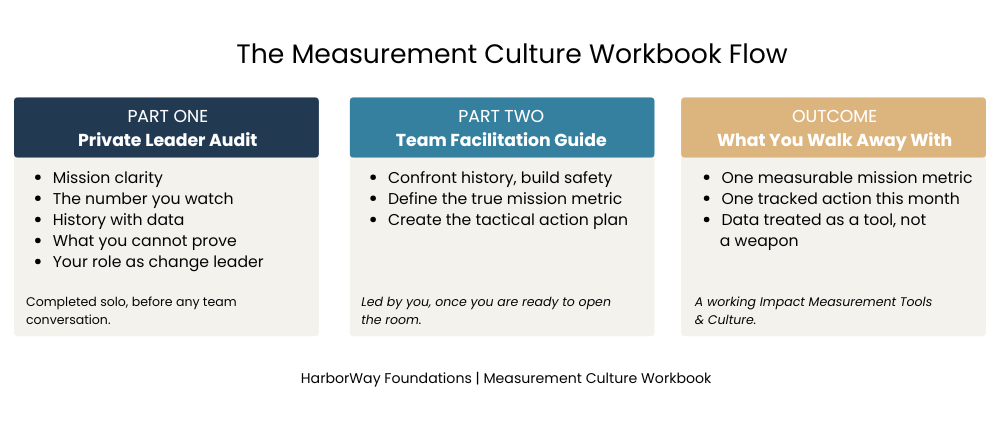
Below is a snapshot of how the process comes together end to end, from private reflection to team-wide practice.
Now, make it happen
You do not have to have impact measurement tools and culture fully built before you start. You have to be willing to look honestly at where you stand today.
To make that easier, HarborWay Foundations built the Measurement Culture Workbook, a two-part tool you can download below. Part One is a private leader audit you complete on your own, built to surface exactly where your organization’s relationship with data is strong and where it is not. Part Two is a team facilitation guide, ready to use once you are prepared to lead the conversation with your staff.
Download: HWF Private Leader Audit & Team Facilitation Guide
Key takeaways
- Caring about a mission and measuring it are two different disciplines.
- Resistance to data is usually inherited history, not laziness.
- Survival metrics and mission metrics are both necessary, and each needs different cultural handling.
- Real impact measurement tools and culture start with a private leader audit before it becomes a team conversation.
Every mission deserves evidence that matches its ambition.
If you’re ready to build a measurement culture that strengthens your mission instead of slowing it down, we’d love to partner with you. Connect with HarborWay Foundations.