

Summary & Key Takeaways
- Shift Messaging to Outcomes: Effective messaging is never about what you do; it is strictly about the specific problem you solve and the future state your customer experiences.
- Eliminate Siloed Friction: Sales teams fail to close leads when leadership, sales, and external agencies operate without a shared strategic north star.
- Operationalize Communication: Aligning teams requires a repeatable operational system with scheduled check-ins and shared accountability, not just sporadic meetings.
- Attract Five-Star Fans: Use HarborWay Foundations’ 3-column evaluation rubric to map where you win, where competitors win, and explicitly who you are not for.
The Problem: High Lead Volume, Zero Conversions, and Team Friction
It is a scenario leadership teams face all too often: paid ad campaigns are running, website traffic is up, but the sales team is not closing deals. You are not attracting 5-star fans.
When performance stalls, the blame game begins. Marketing points at sales execution, sales points at lead quality, and the outside agency operates completely blind because executive leadership keeps internal business performance private.
The root cause of this breakdown is rarely a lack of effort. It is a dual failure of mission clarity and operationalization. Teams operate with competing agendas, siloed data, and no single source of truth to guide daily choices. Without a shared system, team communication devolves into an adversarial dynamic where individual departments focus on their own metrics rather than collective business growth.
The Solution: The HarborWay 5-Star Fan Alignment Engine
To fix lead drop-off and align cross-functional teams, organizations need more than a campaign calendar. They need a structured framework. The HarborWay 5-Star Fan Alignment Engine bridges high-level strategy with daily execution across three core steps:
- Unbiased 5-Star Prospect Profiling: Define the exact attributes of your ideal customer based on solved outcomes.
- Operationalized Cross-Team Communication: Build shared reporting systems across sales, leadership, and external partners.
- The Five-Star Fan Grid Evaluation Tool: Deploy the HWF rubric to qualify the right buyers and filter out poor fits.
Step 1: Define Your 5-Star Prospect Profile Around Solved Outcomes
Your messaging must focus entirely on the future state your solution creates. A 5-Star Fan is not simply anyone who leaves a positive review; it is the exact person or organization you were always built to serve.
Checklist: The 4 Attributes of Attracting 5-Star Fans
- Expectation Alignment: They received exactly what they anticipated during the sales process.
- Value Equity: They feel the value exchange was completely fair.
- Prioritized Need: They had an urgent, active need for the exact challenge you solve.
- Future-State Realization: They are currently experiencing the specific, improved outcome you promised.
By building your messaging around the exact scenarios and attributes of your 5-Star Fans, you create an unbiased prospect profile that serves as an operational north star for marketing and sales.
Step 2: Operationalize Communication and Systems Across Teams
Communication across sales, leadership, and external agencies cannot rely on goodwill alone. It must be embedded into your operational cadence.
To eliminate siloed data and adversarial dynamics, put your communication system into motion:
- Cadence & Check-ins: Establish mandatory bi-weekly alignment meetings where sales, marketing, and agency partners review the same data pool.
- Data Ownership: Assign clear responsibility for who pulls performance metrics and updates the central dashboard.
- Shared Metrics: Evaluate performance based on full-funnel business outcomes rather than isolated vanity metrics.
For a deeper dive into streamlining team operations, explore our guide on AI Workflows for Lean Mission-Driven Organizations.
Step 3: Execute The Five-Star Fan Grid Rubric
Across industry benchmarks, 5-Star Fans converge on five repeatable themes when evaluating prospective vendor partners: competence/outcome, delivery reliability, track record/trust, contextual understanding, and perceived value.
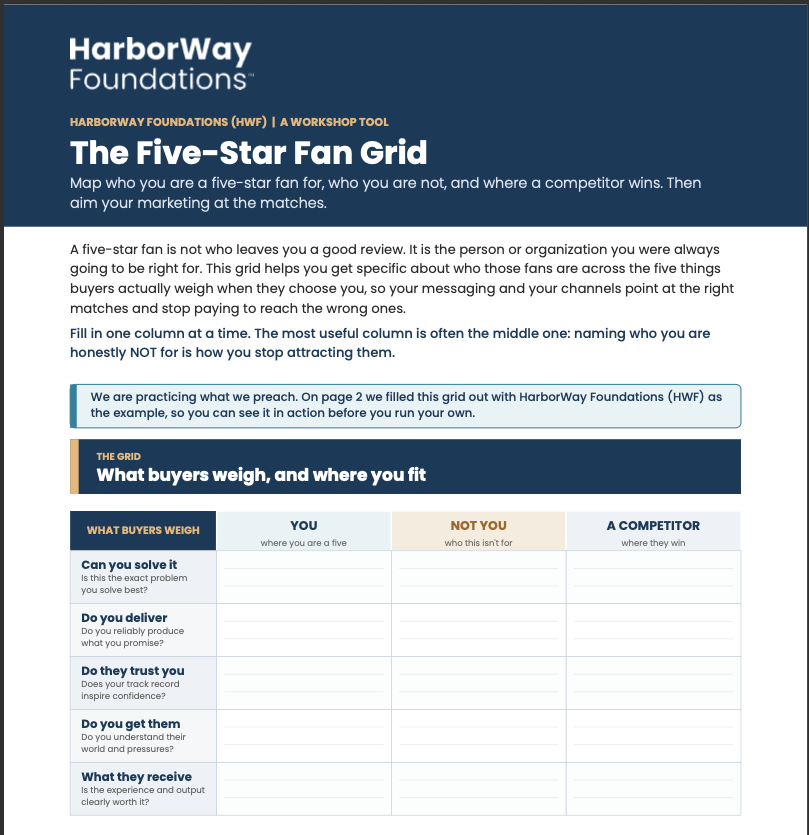 | To capitalize on these themes, deploy The Five-Star Fan Grid. This 3-column tool helps you map your positioning against what buyers actually weigh: |
Map who you are a five-star fan for, who you are not, and where a competitor wins. Then aim your marketing at the matches. Here is the grid we developed for HarborWay Foundations.
| What Buyers Weigh | YOU (Where You Are a 5-Star Fit) | NOT YOU (Who This Isn’t For) | A COMPETITOR (Where They Win) |
|---|---|---|---|
| Can you solve it? Is this the exact problem you solve best? | Specific situations where you are unbeatable | Profiles that need execution hands without strategic clarity | Agencies hired solely for isolated volume/deliverables |
| Do you deliver? Do you reliably produce what you promise? | Runnable operating systems and clear frameworks | One-off campaigns with no follow-through | Big-firm consulting: thorough but expensive and slow |
| Do they trust you? Does your track record inspire confidence? | Lived experience as practitioners inside the sector | Buyers seeking big-name logos over deep sector fluency | Large firms with high brand recognition |
| Do you get them? Do you understand their world and pressures? | Purpose-driven organizations and social enterprises | Purely commercial orgs with no mission dimension | Generalist agencies treating you like any other client |
| What they receive Is the experience clearly worth it? | Credibility, funding readiness, and measurable growth | Buyers shopping strictly on lowest price per item | Low-cost vendors selling volume over outcomes |
Implementation Guidance for Small Teams
How to turn the grid into a marketing move:
- Name who you are NOT for:
The middle column is the most important. Clearly stating who your solution is not for stops you from paying to market to the wrong leads.
- Identify real competitor strengths:
Note where alternatives legitimately win. Where they beat you is not your battleground.
- Pull your core message:
Your primary marketing headline lives where you are strongest and competitors are weakest, pulled directly from your
YOUcolumn. - Aim your channels:
Put your brand where your fit already gathers. Always align fit first, then channel.
If you have a 1-2 person marketing or development team, start here:
- Interview 3 existing 5-Star clients or donors to extract the exact “future state” language they use.
- Complete a 1-page version of The Five-Star Fan Grid to explicitly identify who you are NOT for.
- Set up a bi-weekly 30-minute sync between sales/fundraising and marketing to review incoming lead quality against that grid.
Simple Metrics to Measure Success
Track these straightforward signals to ensure your Go-To-Market Alignment Engine is working:
- Lead-to-opportunity conversion rate: Percentage of incoming leads qualified as 5-Star prospects.
- Sales and agency alignment velocity: Reduction in time required to resolve messaging or targeting disconnects.
- Customer/donor retention signals: Consistent post-onboarding satisfaction based on expectations set during the sales process.
Frequently Asked Questions (FAQ)
Attracting 5-star fans requires consistent execution across every audience touchpoint. Mission drift occurs not because teams lack dedication, but because communication is often separated from daily operations. Operationalizing your mission embeds strategic clarity directly into roles, check-ins, and governance, ensuring your brand message remains clear and credible as you grow.
Without an unbiased profile, the loudest voice in the room often dictates target audience assumptions. Creating a data-backed profile grounded in real customer outcomes ensures your team focuses resources exclusively on prospects who actively need, value, and retain your service.
A complete Go-To-Market plan must include cross-team communication protocols, operational data-capture loops, and value-based buyer evaluation rubrics like The Five-Star Fan Grid. It goes beyond publishing dates to align timing, messaging, and internal capacity around how prospects actually evaluate and select vendor partners.
How HarborWay Foundations Can Help
If you are ready to stop scattering effort across disconnected campaigns and build a runnable strategy, HarborWay Foundations can help. We provide on-demand strategic planning and drop-in support to help growing mission-driven organizations sharpen choices, align internal teams, and build reliable growth engines.
Want a sharper read on your fit? Take the free HWF Pulse Check to see where your strategy is holding and where it is leaking. Start a Conversation with HWF.