How Do You Navigate Economic Shifts Without Sabotaging Future Growth?

Economic shifts put mission-driven organizations in a tough spot. Revenue changes, funding tightens, demand moves, and suddenly leaders are being asked to make big decisions with very little room for error.

Cutting costs can create immediate breathing room. But when those cuts reach the people, systems, relationships, and capabilities that took years to build, the short-term savings can come with a much bigger long-term price.

The goal is not to freeze everything in place. It is to know what needs to flex, what needs to stay protected, and where existing assets can be put to work in new ways. That is the difference between reacting to economic change and building an organization that can move through it.

Summary & Key Takeaway: How to navigate economic shifts

  1. Some Cuts Do Not Heal:

    Knee-jerk budget cuts and footprint reductions in response to short-term downturns often destroy decades of institutional investment and cost far more to rebuild later.

  2. Distinguish Fixed Capacity from Variable Demand:

    Revenue volatility exposes the danger of funding models that treat core operations as purely variable costs.

  3. Reposition Existing Assets Before Abandoning Them:

    When market conditions shift, the solution is rarely to scrap core offerings; it is to reframe them from isolated features into critical infrastructure.

  4. Protect Legacy Knowledge Through Upskilling:

    Organizations that retrain internal staff and preserve core capabilities bounce back faster when the economic cycle inevitably recovers.

The Problem: The Hidden Trap of Reactive Downsizing

When external pressures mount, leaders face immediate panic. Across every sector, external pressures are accelerating simultaneously: demographic shifts, persistent inflation, intensifying competition, and shrinking funding pools.

The instinctive reaction is often a reflexive contraction. Organizations rush to slash budgets, freeze initiatives, reduce staff, and shrink their operating footprint. But reactive cuts made to balance a single budget cycle frequently create structural damage that lasts for years.

This dynamic is playing out vividly in Texas public schools. Facing a drop of nearly 76,000 students driven by falling birth rates, demographic shifts, and the expansion of parallel choices like Education Savings Accounts (ESAs) and charters, districts have slated at least 130 campuses for closure or consolidation over two years.

The immediate math looks tidy on a balance sheet, but the operational reality is more complicated:

  • Texas public school infrastructure represents decades of public investment across 9,000 campuses serving 5.5 million students.
  • When a neighborhood school closes, reopening it years later is rarely possible on the same footprint, forcing communities into expensive commercial leases or costly new builds.
  • Core operating costs do not scale down in neat lockstep with demand; a building, a principal, and baseline staff are required whether an organization serves 400 people or 280.

The lesson applies far beyond school districts. Cut core capacity too deeply in response to short-term headwinds, and rebuilding that trust, footprint, and capability during an economic rebound can cost significantly more than preserving some flexibility today.

The Solution: The HarborWay Foundations Operational Continuity Framework for How to Navigate Economic Shifts
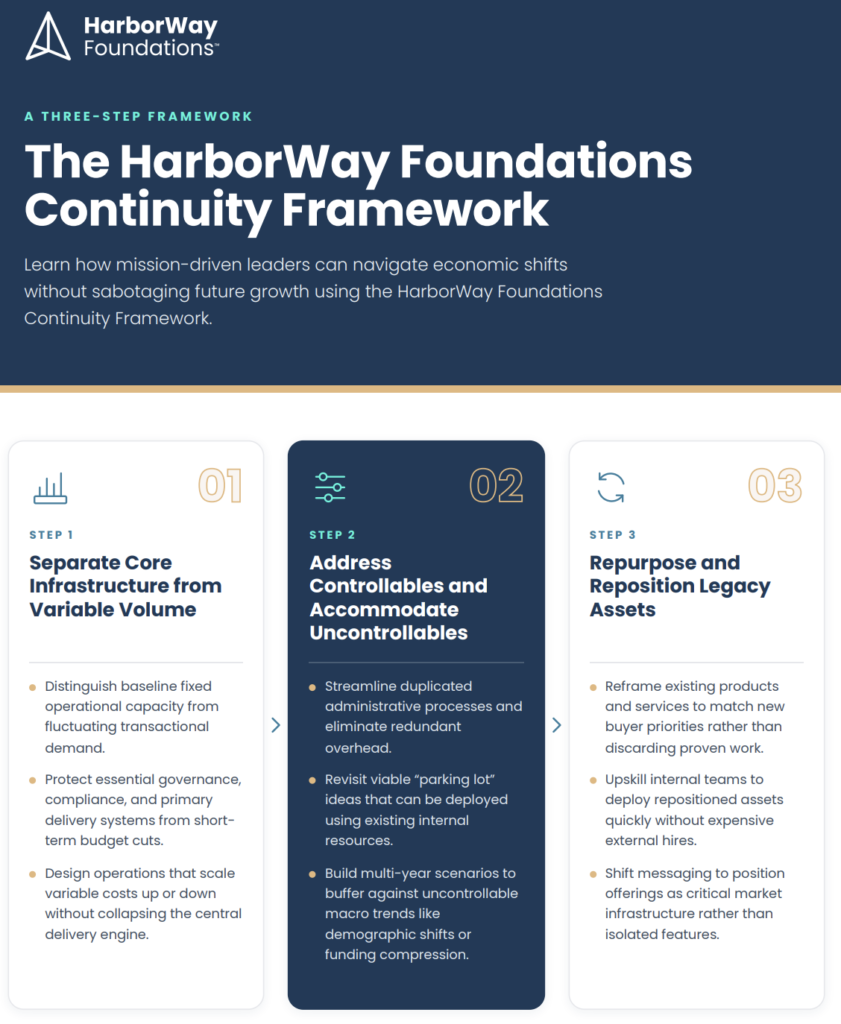
Navigating uncertainty requires a structure that flexes without breaking. The HarborWay Foundations Operational Continuity Framework provides a disciplined method to manage economic shifts without dismantling future capacity:

  1. Separate Core Infrastructure from Variable Volume: Distinguish baseline fixed capacity from fluctuating transactional demand.
  2. Address Controllables and Accommodate Uncontrollables: Move swiftly on internal cost leaks and workflow bottlenecks while establishing buffers for macro demographic or funding trends.
  3. Repurpose and Reposition Legacy Assets: Reframe existing products and upskill internal teams to match new buyer priorities instead of discarding proven work.

Step 1: Separate Fixed Foundation Costs from Variable Demand

In the Texas school finance system, funding follows Average Daily Attendance, creating immediate budget volatility whenever student counts fluctuate. The formula assumes operating expenses fall neatly alongside attendance, ignoring the fixed reality of core facilities and baseline administrative leadership.

Mission-driven leaders often make the same mistake by treating operational infrastructure as discretionary.

  • Audit Your True Base: Identify the irreducible core of your operation, including essential governance, compliance, primary delivery systems, and key leaders.
  • Avoid Flawed Cost Reductions: Do not eliminate high-leverage foundational assets to solve short-term margin deficits.
  • Protect Flexible Capacity: Design operations that can scale variable project costs up or down without collapsing the central delivery engine.

Step 2: Act Rapidly on Controllables, Accommodate What You Cannot Shift

Macroeconomic inflation, state legislative changes, and demographic cliffs are beyond your control. What remains entirely within your control is how your organization manages internal resources, prior initiatives, and operational discipline.

  • Sift the “Parking Lot”: Revisit viable ideas previously set aside because business was steady.
  • Eliminate Redundant Overhead: Streamline duplicated administrative processes and overlapping systems that dilute focus.
  • Build Predictable Runways: Model scenarios around multi-year enrollment, client, or donor pipelines rather than reacting quarter to quarter.

Step 3: Reposition Existing Assets Instead of Throwing Them Out

When performance declines or growth stalls, organizations frequently assume their core offering needs a complete overhaul. In reality, the service is often fundamentally sound, but its narrative and positioning have failed to adapt to current buyer constraints.

Consider HyverHub, a full-service fulfillment partner serving mission-driven organizations in healthcare and education. They had deep, cross-sector capabilities, including warehousing finished products, producing pre-sale materials, and managing API-driven shipping. But their instinct was to say everything to everyone, resulting in a diluted message that resonated with no one. The operational assets were highly valuable; what they needed was a go-to-market story as focused as the work itself.

Instead of abandoning or rebuilding their core service lines, HarborWay Foundations partnered with HyverHub to evaluate where they were already winning and reposition their existing capabilities.

  • Reframed the Value Proposition: Rather than pitching commodity fulfillment features, HyverHub was repositioned as a strategic partner that understands the operational complexity and brand trust behind every order it fulfills.
  • Targeted Revenue-Focused Buyers: The messaging architecture was sharpened to speak directly to the procurement leads, marketing directors, and operations managers who actually sign contracts, without artificially narrowing the broader market.
  • Equipped the Internal Team: HarborWay Foundations defined targeted Ideal Customer Profiles (ICPs) and built pitch decks, outreach copy, and sales tools so the internal team could open conversations immediately.

The outcome proved the power of repositioning: HyverHub secured a clear, consistent story and a scalable go-to-market plan without discarding their established operational foundation.

Implementation Guidance for Small Teams

If you operate with a lean staff of 1 to 3 people, execute these low-lift steps:

  • Run an Asset Inventory: List your existing core services, tools, or published assets; identify which ones can be repackaged for immediate revenue rather than developing new offers from scratch. Check out The Four Phases Mission ROI Lens
  • Isolate Fixed Overhead: Calculate your absolute minimum operating cost per month; avoid cutting the 1 or 2 core operational tools that generate your pipeline.
  • Upskill via Drop-In Support: Partner with an external drop-in team that embeds alongside your staff to design strategy and execute campaigns. Have them train one key internal member on critical workflows, ensuring outside help builds lasting in-house capability rather than permanent dependency. Check out The Four Strategy Lanes

Simple Metrics to Measure Success

Track these operational indicators to verify you are building resilience rather than setting off a cycle of organizational decline:

Core Capacity Retention Rate: Percentage of essential program infrastructure and key talent preserved through budget adjustments

During the early months of the COVID-19 pandemic, semiconductor suppliers diverted parts away from the auto industry to consumer electronics. When vehicle demand rebounded rapidly, automakers like Ford lacked the core components to build cars, causing a 33.1 percent sales decline in August 2021 and costing the global auto industry billions in lost revenue.

Repurposed Asset Velocity: Turnaround time required to re-message and deploy an existing offering into a new market channel.

Stanley turned its 40-ounce insulated cup from a utilitarian camping item into a fashion accessory by partnering with a women’s commerce blog. Introducing new colors to this targeted audience transformed a discontinued item into a viral success, growing the company’s annual revenue from $70 million to over $750 million in just four years.

Fixed-to-Variable Cost Ratio: The operational proportion between stable baseline costs and adjustable programmatic expenses.

A prime example of improving this ratio is using an outside agency to build out a one-time program playbook. This approach leverages outside expertise and protects internal capacity while creating a ready-to-execute plan. It also gives the initiative room to be evaluated objectively, without internal assumptions or ownership getting in the way. This is exactly where HarborWay Foundations can be brought in as a strategic partner. To see where your current strategy holds and where it leaks, take the free HWF Pulse Check.

Frequently Asked Questions (FAQ)

How do we know if a proposed cut is a knee-jerk reaction?

A cut is a knee-jerk reaction when it eliminates core operational capacity, discards valuable institutional knowledge, or permanently shuts down facilities to meet an arbitrary single-cycle target. If rebuilding that capacity during an eventual uptick will cost more than the money saved today, the cut is shortsighted.

Why is it better to reposition an existing product than launch a new one during a downturn?

Launching a brand-new initiative requires heavy capital, long development cycles, and significant market testing. Repositioning an established product leverages your existing credibility and infrastructure, aligning your proven value with current buyer budget priorities in a fraction of the time.

How can organizations protect themselves against enrollment or client volatility?

Organizations must separate their fixed baseline operational expenses from their variable service costs. Relying entirely on per-unit or attendance-based revenue models leaves zero cushion during downward shifts, creating instant operating deficits that threaten organizational survival.

How HarborWay Foundations Can Help

Navigating economic downturns requires strategic discipline, not reactive panic. HarborWay Foundations provides on-demand strategic planning and drop-in advisory support to help mission-driven organizations protect their core capacity, reposition key offerings, and build flexible operating systems that outlast market disruption.

HarborWay Foundations Launches Online Tool to Give Mission-Driven Leaders a Quick Read on Their Organization in Just Two Minutes

Free online assessment helps business and nonprofit leaders find gaps and take action to strengthen ROI and impact

BOSTON, May 4, 2026 – Less than half of U.S. businesses survive five years, and only about one-third make it to 10 years. To help both for-profit and nonprofit organizations beat the odds, HarborWay Foundations (HWF) has introduced the HWF Pulse Check. This online self-assessment gives leaders a snapshot of what’s working in their organization and where there’s room to grow.

Designed for executive directors, founders, CEOs, and senior leaders, the HWF Pulse Check evaluates four areas critical to sustainable growth:

  • Mission and vision alignment
  • Messaging clarity and consistency
  • Marketing and communications execution
  • ROI and impact 

In just two minutes, leaders receive a score in each area, along with practical steps to move their marketing and communications in the right direction.

“In many nonprofits and mid-market companies, leaders are expected to deliver big results, but often with limited resources and little support,” said HarborWay Foundations Founder and CEO Javier Encinas. “HarborWay Foundations was created to expand access to senior-level strategy in marketing and communications without the full-time commitment — and the HWF Pulse Check gives organizations an easy starting point.”

Built from HarborWay Foundations’ experience across a variety of sectors, the HWF Pulse Check is useful for organizations at any stage, from early startups to established organizations. According to Encinas, the assessment is particularly valuable during strategy shifts, leadership transitions, or periods of increased pressure from funders, members, or boards.

“For leaders looking for quick guidance, the HWF Pulse Check delivers clear insights and low-lift ways to close gaps or build on existing momentum,” said Encinas. “For leaders ready to go deeper, HarborWay Foundations can help them design the strategies, language, and structures they need to thrive — not just survive — over the long haul.”

Leaders can take the free HWF Pulse Check at: https://HarborWayFoundations.com/HWF-Pulse-Check

About HarborWay Foundations

HarborWay Foundations (https://harborwayfoundations.com) provides marketing and communications strategy and services for mission-driven organizations. It partners with nonprofit and for-profit leaders to create marketing strategies and structures that align mission, money, and impact so meaningful work leads to sustainable results. 

Media Contact

HWF Communications

hello@harborwayfoundations.com

AI Workflows for Lean, Mission-Driven Organizations

Getting workflows right (and maintaining them over time) makes a huge difference in making the most of every tool and resource available to your team, including AI. A recent Harvard Business Review article describes the current state of AI use, productivity expectations, and professional life. The recommended actions are practical. The gap is in actually doing them, not just talking about them.

Coordinating how your team uses AI is the most effective first step to leveling up without overloading. Here’s how AI can make your team and your work better.

Build the Workflow Habit, Not Just the Tool

AI is a step in the work, not the final product. A few practices that make the difference:

  • Schedule reflection steps. The work is now editing and judgment. Take time to check whether the output aligns with the original ask, is accurate, and isn’t just regurgitated content.
  • Sequence the work. Know where AI fits in your process before you start, not after.
  • Deliberately review. Invite colleagues to review your AI-assisted work, and do the same for theirs. Shared standards build shared quality.

Use Your Work Cycles, Not Just Your Calendar

Every organization has seasonality. Low-activity periods are an underused asset for reflection, celebration, and honest critique of what’s working.

AI can be a surprisingly useful input during these windows: reviewing program performance, stress-testing messaging, or simply asking “what patterns do we keep missing?” Use the quiet seasons to build the systems that carry you through the busy ones.

Board & Leadership Support

Board members are often time-starved volunteers without bandwidth to synthesize long reports. AI can reduce that friction without reducing quality:

  • Convert staff reports into executive summaries for board packets
  • Generate discussion questions from strategic documents ahead of meetings
  • Draft board recruitment materials, role descriptions, and onboarding guides
  • Help prepare CEOs and Executive Directors for fundraising conversations by building donor briefings quickly

Outdated Policy, Current Reality

There’s a whole class of internal documents that were written once and never touched again. AI can audit them and bring them up to date: Ask “What in our organization is stuck in the year it was written?” Start here:

  • Travel & expense policies: rewritten against current per diem rates, rideshare norms, and hybrid event travel
  • HR and onboarding documents: updated to reflect current labor law, benefits options, and hybrid work expectations
  • Vendor and procurement guidelines: especially relevant as software subscriptions have replaced many traditional contracts
  • Communications policies: most nonprofits have social media policies written in 2014 that say nothing about AI-generated content or employee advocacy

Constituent & Program Insights

Understanding who is actually engaged with your programs (and who isn’t) can feel like a daunting data task. It doesn’t have to be. With built-in AI tools in most spreadsheet and CRM platforms, you can get meaningful answers without a data team or BI platform:

  • Highest engagement: identify which constituents, partners, or program participants show the most activity, and get a breakdown by geography or profile
  • Recent drop-off: find average engagement over a set period and surface the sharpest declines in the most recent window
  • Never activated: identify pockets of non-participation by geography, program type, or audience segment

This kind of insight helps small teams make smarter decisions about where to invest limited outreach energy.

Campaign & Messaging Performance

If you’re tracking direct outreach including emails, social, and events, AI can help you find patterns in what’s working and what isn’t. Feed it your performance data alongside your messaging and ask it to surface the difference between your highest and lowest performers.

Just be intentional about the success signal: are you measuring site traffic, responses, or donations? The answer shapes everything.

Your workday looks different now. Not just in what you’re doing, but in how you do it. Making the shift to AI as a team ensures it supports your best work rather than replacing it or diluting it. The goal isn’t to do more. It’s to do what matters, better.

Ready to build AI workflows for your lean, mission-driven organizations that actually work?

HarborWay Foundations helps mission-driven organizations design the approach, language, and structures that let mission, money, and impact move in the same direction. Let’s talk

The New Search: How AI Overviews and Chatbots Are Changing How People Discover Nonprofits 

In 2026, digital discovery is shifting from web links and search rankings to AI-generated summaries and conversational assistants. For nonprofit leaders, understanding how donors, beneficiaries, and partners encounter organizations in this new landscape is crucial for mission visibility, funding, and trust.

Today, more searchers receive answers directly on the results page through AI Overviews, rather than clicking into individual websites. Donors and partners rely less on sifting through pages of search results and more on instant, AI-powered responses from Large Language Models (LLMs) such as ChatGPT, Google Gemini, and Perplexity.  

What Are AI Overviews and LLMs? 

AI Overviews are generative-AI summaries placed above Google Search results. They draw from Google’s indexed web pages and deliver a compact answer with relevant links. (1) 

LLMs operate via what’s called Retrieval-Augmented Generation (RAG). This approach retrieves live web data from websites, articles, research reports, and even community platforms like Reddit or Quora to craft natural, human-like responses. (2) 

These technologies now surface nonprofits not just based on keywords and backlinks, but on transparency, quality of storytelling, and clarity of mission. 

Put simply: 

  • AI Overviews summarize Google-indexed sources.
  • LLMs/chatbots blend live web data and learned context to generate natural language answers. 

3 Reasons Why the Age of AI Search Matters 

  1. Visibility Without Clicks: AI Overviews and LLMs summarize information without requiring a click, so your website may capture fewer direct visits. Visibility now depends on the strength of your story and the clarity of your impact, not just keywords and links. 
  2. Trust Begins Before the Visit: Searchers form judgments based on what AI tools say about you before they ever reach your homepage. Algorithms highlight organizations that show authentic outcomes, clear missions, and active engagement.  
  3. Consistency Builds Credibility: Inconsistent or outdated public messaging can result in missed opportunities for discovery in AI-generated overviews. Clear messaging, transparent impact data, and mission-driven storytelling allows nonprofits to shape how they appear in AI-powered search results. 

Where does the Opportunity Lie? 

This shift in AI-driven search offers nonprofit organizations a chance to shape how their missions are understood and trusted. The opportunity lies in clear, consistent messaging, transparent impact data, and authentic, mission-driven storytelling. 

When you back up your claims and describe them in everyday language, AI is more likely to feature your work. Early adopters who refine their content and maintain consistent public profiles will earn trust and visibility. By leading with clarity and transparency, nonprofits can define how their stories show up in this new landscape of AI-powered discovery. 

Practical Steps to Prepare 

Run HarborWay Foundations’ four-step visibility audit to understand your organization’s digital footprint. 

  1. Search five to 10 questions a typical donor, volunteer, or service recipient might ask about your mission. 
  2. Check if your organization appears in AI Overviews or LLM/chatbot answers. Document what you do or do not find. Pay attention to which competitors or market dominators surface in the answers and document the source content cited.
  3. Review your findings and identify what needs improvement. If you already have relevant pages, assess whether your content clarity or impact framing needs refinement 
  4. Create a 6–12-month plan to improve how your mission appears across these emerging discovery channels.  

If you want to better understand how your organization stacks up, HarborWay Foundations can help. Together, we’ll build a strategy to stay visible in the age of AI discovery. 

Leading with Equity: How Organizations Are Making AI Inclusive and What You Can Learn 

In Part 1 of this series, we explored AI’s cultural blind spots and how tools can miss the mark when they’re built without the full spectrum of human experience in mind. In Part 2, we dug into the role of inclusive leadership and why human judgment is essential for steering AI toward equitable outcomes. 


Together, these conversations point to a simple truth. AI reflects the choices, values, and perspectives of the people who build it. And when those perspectives aren’t diverse, the technology isn’t either. Left unchecked, AI can quietly reinforce inequities, undermine trust, and work against the very missions our organizations are trying to advance. 

But here’s the good news: many organizations are already showing what’s possible when equity in AI comes first. In this post, we highlight real-world examples of organizations leading with equity and share lessons mission-driven leaders can apply right now. 

Why Equity in AI Matters for Leaders 

AI systems that overlook diversity or amplify bias can damage reputations, erode audience trust, and reinforce systemic inequities. For mission-driven leaders, this is both a technical challenge and a strategic one. 

Equity in AI aligns with organizational purpose, ensuring that the tools we use serve all communities fairly, respect cultural contexts, and advance positive social outcomes. By prioritizing inclusive AI, leaders have an opportunity to shape technology that reflects their values and strengthens trust with the people they serve. 

Real-World Examples of Equity in AI 

Latimer.ai: Inclusive Training Data 

Latimer.ai is a standout example of integrating equity from the ground up. Their large language model (LLM) is trained using input from underrepresented communities including folk tales and oral histories from around the world, ensuring that the AI understands diverse perspectives. 

Through partnerships with universities and community organizations, Latimer.ai incorporates cultural nuance and lived experience into its datasets, showing that inclusive training data is foundational for equitable AI outputs. 

Key takeaway: AI that reflects a wide spectrum of experiences produces more balanced results that better represent a diverse audience. 

AI Now Institute: Research and Policy Advocacy 

The AI Now Institute examines the social implications of AI, with a focus on bias, fairness, and equity. Through rigorous research, policy recommendations, and frameworks, they guide organizations in adopting responsible AI practices. 

Their work underscores that responsible AI is a social challenge, and organizations need robust, research-driven insights to make ethical decisions that genuinely advance fairness. 

Key takeaway: Evidence-based research is crucial for understanding where AI falls short and shaping policies that promote equity. 

Inclusive AI Foundation: Governance & Best Practices 

The Inclusive AI Foundation is a nonprofit organization that works to embed ethical, inclusive practices across AI development. Their approach emphasizes structured governance, evaluation frameworks, and community engagement to ensure AI systems serve all populations fairly. 

They offer workshops, consulting, assessments, and road mapping for leaders looking to implement inclusive AI in their own organizations.  

Key takeaway: Governance and stakeholder engagement are essential for embedding equity into AI design and deployment. 

Five Key Lessons for Mission-Driven Leaders 

  1. Audit your AI tools and outputs: Examine datasets and model outputs for underrepresentation and bias. 
  2. Demand cultural filters or adjustable framing: Ensure AI tools allow context-aware outputs tailored to diverse audiences. 
  3. Prioritize values-aware AI: Understand the priorities, values, and constraints of the communities you serve. 
  4. Partner with underrepresented communities: Co-create datasets, evaluation metrics, or prompts to ensure authentic representation. 
  5. Measure, iterate, communicate: Track outputs for bias and inclusivity; make equity part of your organizational standard. 

These practices help leaders translate abstract principles into concrete actions that make AI more inclusive. 

Closing thought 

AI’s cultural blind spots are real, but equity is achievable. Organizations like Latimer.ai, AI Now Institute, and Inclusive AI Foundation demonstrate how inclusive AI is possible when intentionality, research, governance, and community engagement come together. 

Mission-driven leaders can learn from these examples, apply these lessons, and take proactive steps to embed equity into AI initiatives. By doing so, you not only enhance your organization’s impact but also build trust, credibility, and lasting relationships with the communities you serve. 

AI has the power to amplify good, but only if we lead with equity. Let’s make inclusive AI the standard, not the exception. 

Inclusive AI Leadership: Key Questions Leaders Should Ask About Equity and Bias 

In our last post, we explored AI’s cultural bias: the way models tend to mirror Western, educated, urban populations while leaving out many others. That raised the next question: how can leaders practice inclusive AI leadership, ensuring the tools their teams use are equitable, culturally aware, and free from bias? 

The answer is not to learn how to code. Leaders do not need to become technologists. But they do need to hold their tech teams accountable. The most powerful way to start is by asking sharper questions. 

Why inclusive AI leadership matters 

AI is already shaping how we teach, treat patients, respond to climate change, and support communities. The tools you choose now will shape the path your work takes for years to come. 

But this goes beyond simply checking a compliance box. For truly inclusive AI, equity should be embedded into strategy, design, and governance. By making equity and inclusion a core consideration, leaders ensure AI tools reflect the diversity of the communities they serve. 

Failing to do so risks defaulting to solutions designed for the most visible populations, leaving gaps in access, fairness, and trust. Inclusive leadership ensures that technology is accountable, representative, and aligned with organizational values. 

Six questions every leader should ask about AI equity and bias 

  1. Whose voices trained this model? Does the data reflect a wide range of people across regions, incomes, industries, and experiences? Or just English-speaking, affluent ones? 
  1. How does the model handle cultural variation? Can it shift how it responds depending on context, from rural towns to major metropolitan areas? 
  1. Is there a default worldview built in? If so, has it been acknowledged and balanced?  A system that assumes everyone has access to the same education, technology, or financial resources is not neutral. 
  1. What languages and dialects are supported? Does the tool capture nuance, from regional dialects and multilingual phrasing to hybrid forms like Spanglish or local vernacular? 
  1. How is fairness measured? What audits are you running, and do they check for equity across diverse populations, not just the majority? 
  1. Who tested the system before rollout? Did the process include input from a range of users and communities, or mostly technical experts and insiders?

Real-world examples of AI bias across industries 

  • Education: A tool tuned to suburban schools might collapse in a rural district with patchy internet. 
  • Healthcare: A digital assistant may provide advice that fits city hospitals but ignores the long drives and limited options in rural America. 
  • Climate: AI that misses Indigenous ecological knowledge will overlook proven practices, from controlled burns to water management. 

The leadership opportunity: integrating equity into mission 

Across industries, conversations about responsible and equitable AI are gaining traction. The next step is turning those principles into everyday leadership.  

This is about reframing AI equity as part of the mission, not an optional add-on. Asking these questions puts inclusivity on the same list as equity in funding or representation in leadership. 

The upside is trust. People notice when tools reflect their lives. Leaders who demand culturally inclusive AI will stand apart as authentic, responsive, and credible. 

Closing thoughts: building trust through inclusive AI 

AI’s cultural bias is not permanent. Leaders who ask sharper questions now will shape systems that reflect all of humanity, not just the loudest slice. 

In the next part of this series, we will highlight organizations already pushing for equity in AI and what others can learn from their example. 

Meet the Founder: Javier Encinas, HarborWay Foundations™

Oh, you wanted more? I’m flattered. So, I interviewed myself (with some help from the team). Here’s a bit about me and how I founded HarborWay Foundations to help mission-driven leaders grow their organizations with purpose.

Why did you start HarborWay Foundations?

HarborWay Foundations (HWF) was born from a mix of hard knocks, hard lessons, and one very real wake-up call. After decades chasing growth charts and EBITDA lines, I realized too many organizations were sprinting toward “success” without stopping to ask “why.” Then a serious accident in 2022 hit the brakes on everything. Recovery has a way of stripping away the noise. It reminded me that growth only matters if you still recognize yourself in it. HarborWay Foundations exists to help mission-driven leaders grow on purpose, not just on paper.

What kind of work did you do before launching HWF?

I’ve been in the game for over twenty years: marketing, brand strategy, executive leadership. Telecom, education, consumer goods, tech, you name it. I’ve led national campaigns, wrangled big budgets, and herded cross-functional cats. Later, private equity taught me the mechanics of scale, and how easy it is to lose your soul in the process. Those experiences gave me the playbook and the conscience: grow big, but deliver more than a traditional “bottom line.”

What makes HWF different from other marketing consultancies?

We don’t start with content; we start with clarity. Most firms crank out campaigns. We build marketing and communications engines that connect vision to measurable outcomes. HWF helps mission-driven organizations (for-profit and nonprofit) align their message, metrics, and momentum so they can do well and do good, without the fluff or PowerPoint bingo.

How did your background influence your approach to business?

I grew up in a big, working-class Mexican American family in southern Arizona. My dad could fix anything with duct tape and stubbornness. My mom made curiosity a daily habit. That combo became my first lesson in sustainability and creative problem-solving, long before I had a title for it. They taught me that real strategy isn’t written in decks; it’s built in the doing.

Who does HWF work with today?

We work with conscious investors, mission-driven leaders, and nonprofits that want to stop “meaning well” and start moving the needle. Our clients already know what they stand for. They just need the strategy and structure to make it count.

What’s one belief that guides how you lead and collaborate?

That business is the most scalable force for good we’ve got. Growth and good aren’t opposites: they’re dance partners. You just have to pick the right rhythm.

What’s next for HWF?

We’re helping more organizations design sustainable growth models that reflect who they are, not who the market tells them to be. The future belongs to the mission-driven, and we plan to be a force behind it.

Final thought?

Sure. Life handed me a plot twist, and I decided to turn it into a playbook.

If HWF helps one more mission-driven leader build something that shakes things up for good, then every twist was worth it.