
Designing the Working World of Tomorrow with AI: An Operational Framework for Mission-Driven Leaders

Summary & Key Takeaways

  • AI Amplifies Existing Workflows: AI is an outcome extender, not a strategy generator; if your team struggles with operational consistency, adding AI will only accelerate coordination breakdowns.
  • The Hidden Cost on Middle Management: Unstructured AI adoption burdens managers with fire-fighting and validation checks, destroying their capacity to mentor the next generation of leaders.
  • Redesign Systems over Tools: Sustainable AI integration requires continuous training, reliable technical infrastructure, clear governance, and outcome measurement rather than chasing short-term hacks.
  • Protect Leadership Capacity: Organizations must set strict Go/No-Go guidelines to protect managerial time and ensure AI adoption serves long-term goals.

The Problem: Short-Term AI Ambition Is Burnout Strategy in Disguise

A tool is only as good as how it is used. Across the mission-driven sector, organizations are rushing to integrate generative AI. Yet, taking a near-term view of AI integration creates severe downstream issues. Teams set aside long-term talent development to chase the latest model releases, debate brand visibility in generative search, or discover quick productivity hacks.

Recently, Harvard Business Review explored how AI implementation is taxing leadership, pointing out that AI adoption is overloading middle managers. When managers spend their days validating raw AI outputs and putting out operational fires, a critical question arises: Who in your organization is developing the next generation of leaders?

When AI adoption lacks structure, three distinct organizational breakdowns occur:

  • Breakdown 1: Learning is informal, while delivery is relentless. Neither internal teams nor external buyers have a clear roadmap for measuring AI success, leaving managers to figure it out on the fly.
  • Breakdown 2: Incentives reward individual effort over coordination. Using AI effectively requires deep cross-team collaboration, but legacy incentive structures continue to reward isolated, individual output.
  • Breakdown 3: Executive vision disconnects from daily management. Leaders push ambitious AI visions while junior staff execute strategic tasks without traditional oversight. Meanwhile, managers spend all their time auditing work instead of mentoring talent.

AI acts as a force multiplier, but someone still has to ask the right questions, verify the work, monitor performance, and put those outputs to use. Whether AI strengthens your mission depends entirely on the operational structure wrapped around it.

The Solution: The HarborWay AI Capacity Alignment Framework

To prevent AI from derailing your core mission, organizations must move away from isolated software tools and transition to redesigned workflows. The HarborWay AI Capacity Alignment Framework establishes operational efficiencies that protect team capacity, maintain steady progress toward established goals, and ensure long-term excellence.

HarborWay AI Capacity Alignment Framework

A repeatable operational system designed to integrate AI workflows without overwhelming middle management.

1

Continuous Literacy

Commit to continuous AI literacy and training across the team.

  • Communication plans for changing uses
  • Prioritized skill calibration

2

Data & Tech Audit

Ensure reliable data and technical infrastructure are in place.

  • Data completeness review
  • Verify shared understanding of fields

4

Outcome Measurement

Careful measurement of outcomes against established goals.

  • Objective check ins on expected results
  • Clear rules for continuation or discontinuation

3

Governance & Roles

Establish clear governance and internal accountability structures.

  • Shared accountability framework
  • Redistributed workload & technical infrastructure management

Step 1: Commit to Continuous AI Literacy and Training

Rather than expecting staff to learn tools in their off-hours, establish formal communication plans to keep teams updated on changing behaviors, release notes, and practical use cases. Give team members access to structured, on-demand training so their skills evolve as automation replaces manual tasks.

Step 2: Audit Data and Technical Infrastructure

AI models rely entirely on the quality of your underlying data. Conduct regular data audits to assess completeness, eliminate redundant records, and ensure every team member shares the same understanding of core fields and metrics.

Step 3: Establish Clear Governance and Accountability

Define explicit rules for how AI tools are selected, accessed, maintained, and updated across your organization. Assign clear ownership so that governance decisions do not fall onto overburdened middle managers by default.

Step 4: Measure Outcomes with Objective Discontinuation Rules

Schedule regular check-ins to evaluate expected outcomes against actual results. Establish objective “Go/No-Go” guidelines that separate the workflow creator from the evaluation process, allowing your team to scrap ineffective AI experiments without bias.

Mini Case Study Example

A mid-sized education nonprofit integrated AI writing tools to draft grant proposals. Initially, proposal volume increased, but middle managers spent twice as long editing inaccurate statements, destroying their coaching bandwidth. By applying the HarborWay AI Capacity Alignment Framework, the organization established clear data-validation checkpoints and assigned automated drafting strictly to pre-approved templates. Managerial review time dropped by 60%, restoring hours of weekly capacity for staff mentorship.

For practical, low-risk ways to introduce AI across your team, explore our detailed guide on AI Workflows for Lean Mission-Driven Organizations.

Implementation Guidance for Small Teams

If you operate with a lean team of 1 to 3 people, do not attempt to automate everything at once:

  1. Identify Your Core Pain Point: Pick one repetitive, low-risk workflow (such as initial meeting transcript summaries or basic data formatting).
  2. Set Explicit Go/No-Go Rules: Define what success looks like within 30 days. If the tool does not save net hours or improve quality, scrap it immediately.
  3. Protect Mentorship Time: Ensure any hours saved by AI automation are explicitly reinvested into staff development, strategic planning, or direct mission delivery.

Simple Metrics to Measure AI Performance

Track these straightforward signals to evaluate whether your AI integration is adding value or causing operational friction:

  • Managerial Capacity Ratio: Hours spent by managers on high-level leadership and mentoring versus auditing AI outputs.
  • Workflow Cycle Time: Total hours required to move an initiative from idea to completion before and after AI adoption.
  • Outcome Accuracy Rate: Percentage of AI-assisted deliverables that meet quality standards without requiring substantial rework.
Frequently Asked Questions (FAQ)
How do you know if your organization is ready for AI implementation?

AI is a task extender, not an operational fix. If your organization struggles with basic consistency, clear communication, or process documentation, adding AI will amplify that lack of coordination. Organizations are ready for AI when they have documented workflows and clean data infrastructure in place.

Why does unstructured AI adoption overload middle managers?

When leadership encourages AI adoption without clear governance, middle managers absorb the review burden. They end up spending extra hours validating unverified outputs, establishing ad-hoc quality controls, and fixing errors, which leaves no capacity for developing future leaders.

What is the difference between an isolated AI tool and a redesigned AI workflow?

An isolated AI tool is an ad-hoc software application used by individual staff members without shared standards. A redesigned AI workflow integrates the technology directly into team operations with explicit data standards, clear governance, continuous training, and defined evaluation metrics.

How HarborWay Foundations Can Help

Designing a future-proof working world requires balancing technology with human leadership. If you need a partner to build runnable operational structures, protect manager capacity, and align your team around long-term goals, HarborWay Foundations offers on-demand strategic planning and drop-in organizational support.

    Designing the Working World of Tomorrow with AI | HarborWay Foundations

How Do You Attract 5-Star Fans? The HarborWay Go-To-Market Alignment Framework

Summary & Key Takeaways

  • Shift Messaging to Outcomes: Effective messaging is never about what you do; it is strictly about the specific problem you solve and the future state your customer experiences.
  • Eliminate Siloed Friction: Sales teams fail to close leads when leadership, sales, and external agencies operate without a shared strategic north star.
  • Operationalize Communication: Aligning teams requires a repeatable operational system with scheduled check-ins and shared accountability, not just sporadic meetings.
  • Attract Five-Star Fans: Use HarborWay Foundations’ 3-column evaluation rubric to map where you win, where competitors win, and explicitly who you are not for.

The Problem: High Lead Volume, Zero Conversions, and Team Friction

It is a scenario leadership teams face all too often: paid ad campaigns are running, website traffic is up, but the sales team is not closing deals. You are not attracting 5-star fans.

When performance stalls, the blame game begins. Marketing points at sales execution, sales points at lead quality, and the outside agency operates completely blind because executive leadership keeps internal business performance private.

The root cause of this breakdown is rarely a lack of effort. It is a dual failure of mission clarity and operationalization. Teams operate with competing agendas, siloed data, and no single source of truth to guide daily choices. Without a shared system, team communication devolves into an adversarial dynamic where individual departments focus on their own metrics rather than collective business growth.

The Solution: The HarborWay 5-Star Fan Alignment Engine

To fix lead drop-off and align cross-functional teams, organizations need more than a campaign calendar. They need a structured framework. The HarborWay 5-Star Fan Alignment Engine bridges high-level strategy with daily execution across three core steps:

  1. Unbiased 5-Star Prospect Profiling: Define the exact attributes of your ideal customer based on solved outcomes.
  2. Operationalized Cross-Team Communication: Build shared reporting systems across sales, leadership, and external partners.
  3. The Five-Star Fan Grid Evaluation Tool: Deploy the HWF rubric to qualify the right buyers and filter out poor fits.

Step 1: Define Your 5-Star Prospect Profile Around Solved Outcomes

Your messaging must focus entirely on the future state your solution creates. A 5-Star Fan is not simply anyone who leaves a positive review; it is the exact person or organization you were always built to serve.

Checklist: The 4 Attributes of Attracting 5-Star Fans

  • Expectation Alignment: They received exactly what they anticipated during the sales process.
  • Value Equity: They feel the value exchange was completely fair.
  • Prioritized Need: They had an urgent, active need for the exact challenge you solve.
  • Future-State Realization: They are currently experiencing the specific, improved outcome you promised.

By building your messaging around the exact scenarios and attributes of your 5-Star Fans, you create an unbiased prospect profile that serves as an operational north star for marketing and sales.

Step 2: Operationalize Communication and Systems Across Teams

Communication across sales, leadership, and external agencies cannot rely on goodwill alone. It must be embedded into your operational cadence.

To eliminate siloed data and adversarial dynamics, put your communication system into motion:

  • Cadence & Check-ins: Establish mandatory bi-weekly alignment meetings where sales, marketing, and agency partners review the same data pool.
  • Data Ownership: Assign clear responsibility for who pulls performance metrics and updates the central dashboard.
  • Shared Metrics: Evaluate performance based on full-funnel business outcomes rather than isolated vanity metrics.

For a deeper dive into streamlining team operations, explore our guide on AI Workflows for Lean Mission-Driven Organizations.

Step 3: Execute The Five-Star Fan Grid Rubric

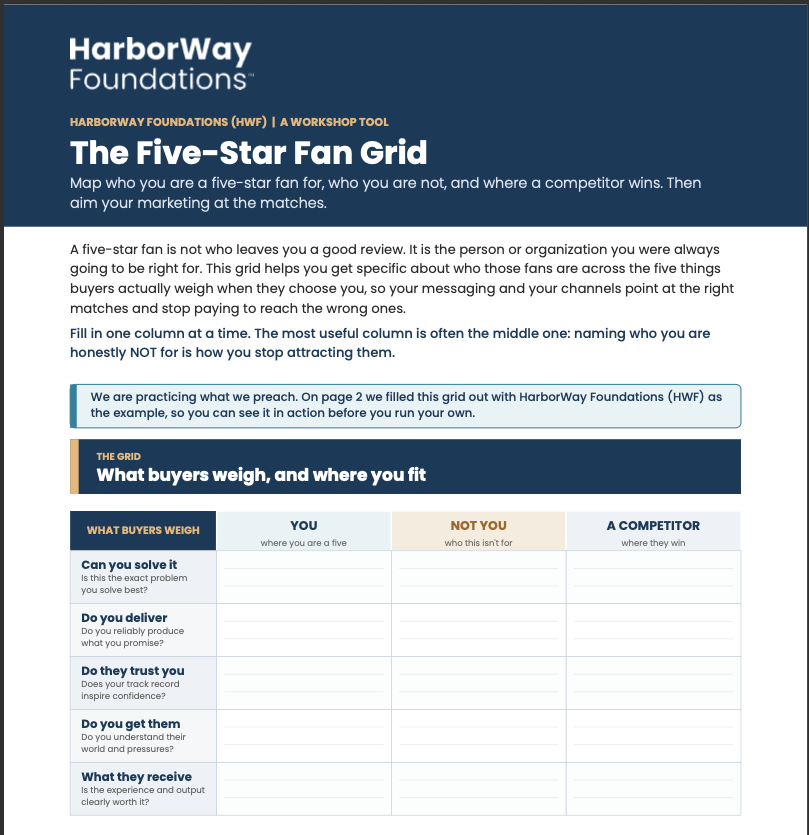
Across industry benchmarks, 5-Star Fans converge on five repeatable themes when evaluating prospective vendor partners: competence/outcome, delivery reliability, track record/trust, contextual understanding, and perceived value.

To capitalize on these themes, deploy The Five-Star Fan Grid. This 3-column tool helps you map your positioning against what buyers actually weigh:

Map who you are a five-star fan for, who you are not, and where a competitor wins. Then aim your marketing at the matches. Here is the grid we developed for HarborWay Foundations.

What Buyers WeighYOU (Where You Are a 5-Star Fit)NOT YOU (Who This Isn’t For)A COMPETITOR (Where They Win)
Can you solve it?
Is this the exact problem you solve best?
Specific situations where you are unbeatable Profiles that need execution hands without strategic clarity Agencies hired solely for isolated volume/deliverables
Do you deliver?
Do you reliably produce what you promise?
Runnable operating systems and clear frameworks One-off campaigns with no follow-throughBig-firm consulting: thorough but expensive and slow
Do they trust you?
Does your track record inspire confidence?
Lived experience as practitioners inside the sector Buyers seeking big-name logos over deep sector fluency Large firms with high brand recognition
Do you get them?
Do you understand their world and pressures?
Purpose-driven organizations and social enterprises Purely commercial orgs with no mission dimensionGeneralist agencies treating you like any other client
What they receive
Is the experience clearly worth it?
Credibility, funding readiness, and measurable growth Buyers shopping strictly on lowest price per item Low-cost vendors selling volume over outcomes

Implementation Guidance for Small Teams

How to turn the grid into a marketing move:

  1. Name who you are NOT for:

    The middle column is the most important. Clearly stating who your solution is not for stops you from paying to market to the wrong leads.

  2. Identify real competitor strengths:

    Note where alternatives legitimately win. Where they beat you is not your battleground.

  3. Pull your core message:

    Your primary marketing headline lives where you are strongest and competitors are weakest, pulled directly from your YOU column.

  4. Aim your channels:

    Put your brand where your fit already gathers. Always align fit first, then channel.

If you have a 1-2 person marketing or development team, start here:

  1. Interview 3 existing 5-Star clients or donors to extract the exact “future state” language they use.
  2. Complete a 1-page version of The Five-Star Fan Grid to explicitly identify who you are NOT for.
  3. Set up a bi-weekly 30-minute sync between sales/fundraising and marketing to review incoming lead quality against that grid.

Simple Metrics to Measure Success

Track these straightforward signals to ensure your Go-To-Market Alignment Engine is working:

  • Lead-to-opportunity conversion rate: Percentage of incoming leads qualified as 5-Star prospects.
  • Sales and agency alignment velocity: Reduction in time required to resolve messaging or targeting disconnects.
  • Customer/donor retention signals: Consistent post-onboarding satisfaction based on expectations set during the sales process.

Frequently Asked Questions (FAQ)

Why is it crucial to operationalize mission clarity when aiming for 5-star fans?

Attracting 5-star fans requires consistent execution across every audience touchpoint. Mission drift occurs not because teams lack dedication, but because communication is often separated from daily operations. Operationalizing your mission embeds strategic clarity directly into roles, check-ins, and governance, ensuring your brand message remains clear and credible as you grow.

Why is it important to create an unbiased profile of your best prospects?

Without an unbiased profile, the loudest voice in the room often dictates target audience assumptions. Creating a data-backed profile grounded in real customer outcomes ensures your team focuses resources exclusively on prospects who actively need, value, and retain your service.

What needs to be included in a Go-To-Market plan beyond a content calendar?

A complete Go-To-Market plan must include cross-team communication protocols, operational data-capture loops, and value-based buyer evaluation rubrics like The Five-Star Fan Grid. It goes beyond publishing dates to align timing, messaging, and internal capacity around how prospects actually evaluate and select vendor partners.

How HarborWay Foundations Can Help

If you are ready to stop scattering effort across disconnected campaigns and build a runnable strategy, HarborWay Foundations can help. We provide on-demand strategic planning and drop-in support to help growing mission-driven organizations sharpen choices, align internal teams, and build reliable growth engines.

Want a sharper read on your fit? Take the free HWF Pulse Check to see where your strategy is holding and where it is leaking. Start a Conversation with HWF.