
Think of the first quarter not as a moment for sweeping, risky reinvention but as an invitation to make everything your nonprofit does just a little bit better. This Forbes piece lays out smart ideas, but what if this year you moved beyond inspiration and actually answered three practical questions:
- What would be a better way?
- Can we do more with what we have?
- What actually changes if our mission succeeds?
The answers live inside your organization if you learn to leverage your internal team for measurable impact.
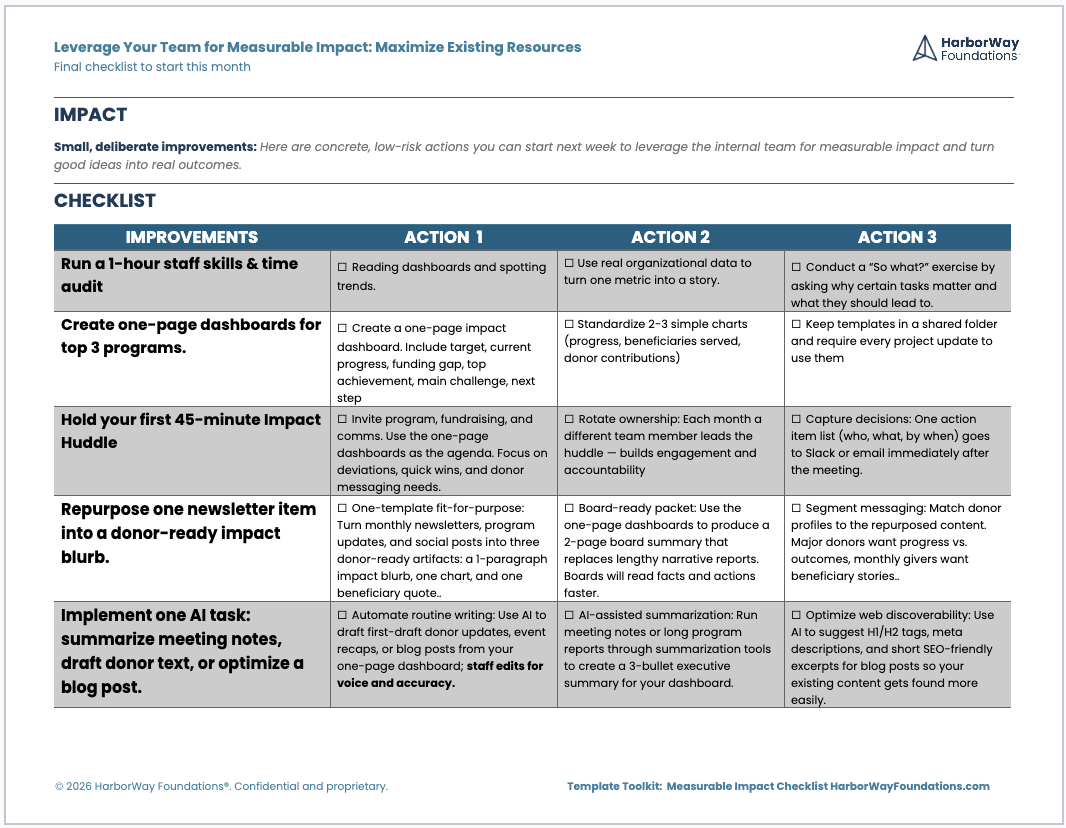
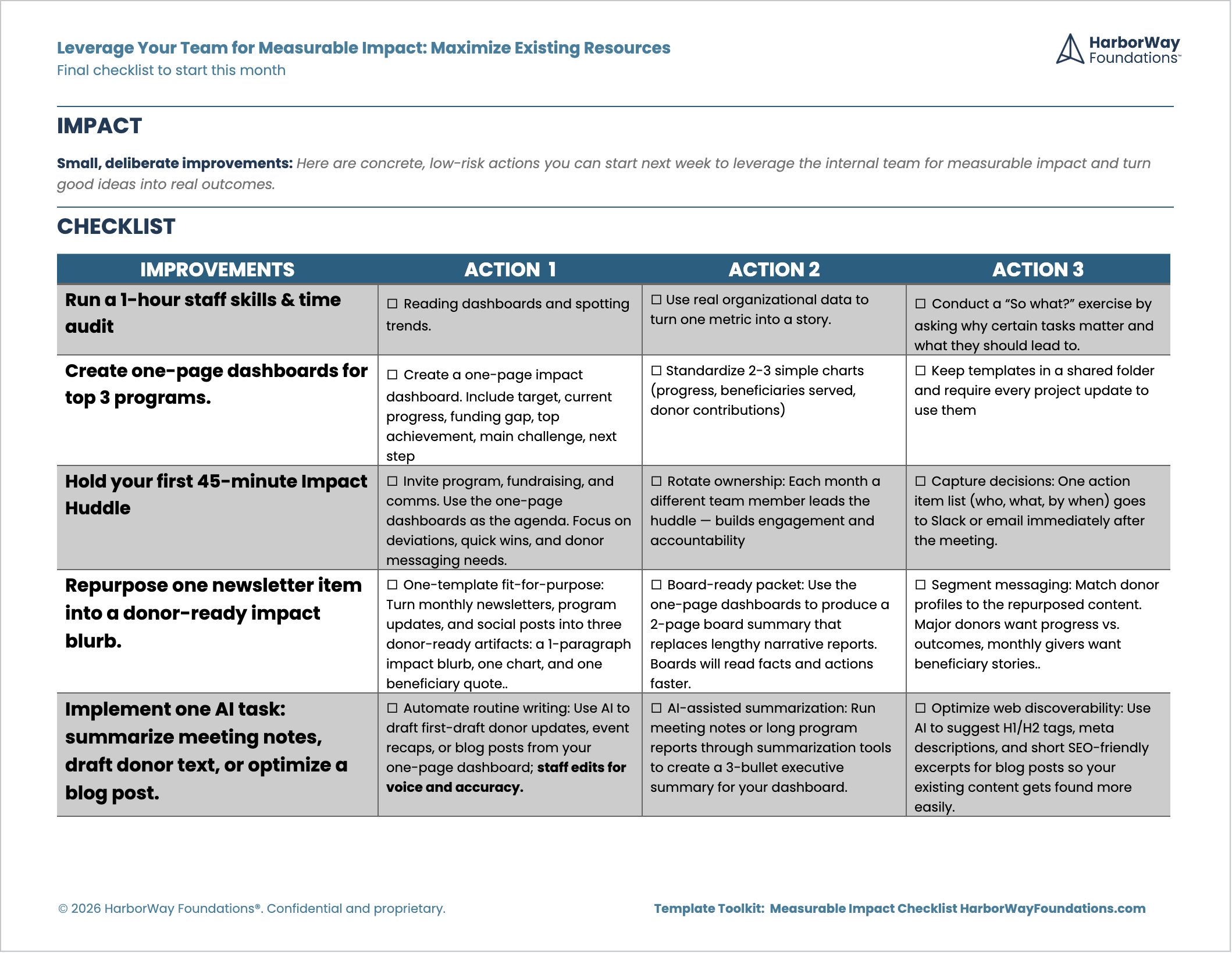
Impact: Maximize Existing Resources
Start by assessing organizational capacity
Map skills, time, and current traction so you know who can do what today and what small gaps are realistic to fill. When you audit internal capacity, don’t just list titles. Capture daily tasks, decision points, and where staff feel stuck. That tells you where platform vs people trade-offs make sense, and helps you determine which functions:
- need human judgment (relationship-building, tailored casework, nuanced partner negotiation)
- can be augmented (data summarization, scheduling, basic outreach)
- can be automated (routine reminders, form processing).
Where repetition dominates, standardize. Where nuance matters, invest in your people.
Turn Data Into Stories
Upskilling staff on data interpretation and storytelling is low-cost and high-return. Teach teams to ask “Why is this interesting?” and “What’s the story here?” then have them write that story. Donor reports, grant updates, and social posts become more compelling when grounded in simple, measurable progress.
Repurpose existing communications for donor and board reporting: adapt newsletters, program summaries, and case studies into tailored impact messages. That’s faster than inventing new content and keeps consistency across audiences.
Use low-cost automation to free staff time for strategy and delivery. Three practical ways to use AI now:
- Auto-draft web copy or blog posts and optimize H1/H2 tags for discoverability
- Summarize program metrics into one-page briefings for leadership and boards
- Auto-tag incoming emails and case notes so staff spend less time searching and more time serving.
These moves buy pockets of strategic capacity without hiring.
Measure what matters
Create donor profiles that tie what donors care about to the metrics you track, then show each donor how their gift changes outcomes. Progress toward goals should be framed alongside the funding gap, so supporters see both momentum and what additional resources unlock.
Standardize simple reporting templates so cross-team input converts quickly into consistent insight. This reduces the time between data collection and action.
Finally, build a monthly impact review rhythm with cross-team input. A short, regular meeting where program staff, fundraisers, and operations share one win, one challenge, and one data point creates an ongoing monitoring loop. Over time, that rhythm surfaces trends early, produces richer stories for communications, and prevents surprises when it’s time to report.
Small improvements lead to scalable impact
Small, manageable improvements add up. Lower-risk experiments are easier to reverse, they sustain growth through constant refinement, and they empower staff to contribute to real change.
If you make measured, team-driven tweaks to processes, reporting, and the use of platforms, you’ll not only do more with what you have. You’ll make the impact you aim for clearer, more credible, and easier to scale.
Start small and stay practical: map where your team spends time, where decisions slow down, and where work repeats. You’ll quickly spot the small changes that unlock bigger impact.
If you’d like an outside perspective on where platforms, processes, or people can create the most leverage, HarborWay Foundations works with mission-driven teams to find those opportunities.